The high-temperature resistant flexible hose is one of the most critical plumbing infrastructure components that ensures the safe extraction of toxic exhaust gases and superheated corrosive air in heavy industry plants, generator rooms, engine test centers, and foundries. Due to their operating principles, modern industrial production lines generate massive levels of heat and harmful chemical vapors. Solvent vapors from plastic injection molding machines, toxic gases in welding workshops, carbon monoxide emitted from generator exhausts, and extreme hot air leaking from iron and steel furnaces directly threaten occupational safety and machine health within the factory. When exposed to these extreme temperatures and chemical abrasions, standard PVC or rubber hoses melt, crack, or catch fire within minutes, creating fatal fire risks for the facility. This is exactly where special industrial hose technologies come into play—manufactured from marvel-of-engineering polymers and fireproof fabrics, and reinforced with steel wire inner structures. Superior durability ventilation and gas extraction solutions, such as the ThermoConnect series offered to the industry with the assurance of ThermoKoTec, ensure that production continues uninterrupted and safely. In this comprehensive engineering guide, we will examine in full detail the vital parameters you need to consider when choosing the right flexible air duct for your facility, the place of hoses in material science, and process-specific ventilation solutions.
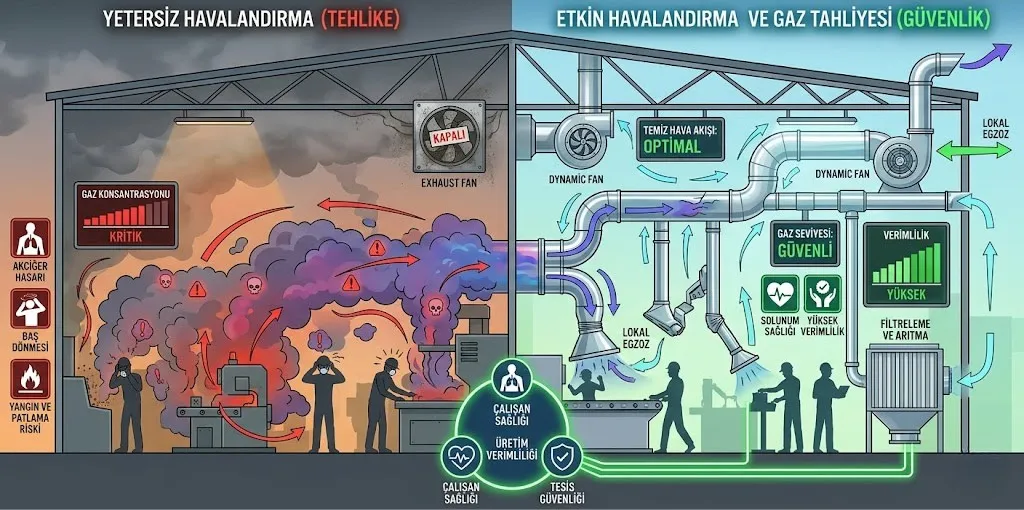
Hot air and toxic gases accumulating in enclosed factory environments or narrow production halls not only threaten the respiratory health of employees but also cause electronic automation panels, sensors, and motors in the environment to fail due to overheating. Occupational Health and Safety (OHS) standards and international environmental regulations mandate that toxic emissions originating from production processes be captured at the source and safely transferred to the outside atmosphere or filtration systems.
The heart of this extraction process is the lines that suck the gas from its source and carry it to the filter. While metal pipelines (rigid ducts) can be used in stationary systems, flexibility is absolutely required in moving machine parts, vibrating generator motors, or local exhaust arms (articulated arms) that need to be manually directed by the operator. Building a system that maintains its form under continuous stretching, bending, and vibration, and resists fireball-like gases at 400°C, 700°C, or even 1100°C passing through it, requires an advanced high-temperature resistant flexible hose architecture. Incorrect selection of the material you will use in your installation will lead to loss of suction (vacuum drop), toxic gas leakage into the production area, and high revision costs.
The ability of a flexible industrial hose to withstand extreme conditions depends on its layered material structure and internal skeletal engineering. Although it looks like a simple pipe from the outside, a high-quality gas extraction hose contains high-tech polymers used in the aerospace and aviation industries. The primary materials used in the production of these hoses and their chemical advantages are as follows:
Silicone is the most preferred material, especially in furnace ventilation between 250°C and 300°C, drying facilities, and hot air circulation in the plastics industry. These hoses, produced by coating fiberglass fabric with special flame retardant silicone, offer excellent flexibility. By its nature, silicone has a very high resistance to ozone, UV rays, and atmospheric aging. The fiberglass texture, which prevents the hot air passing inside from burning the fabric, increases the tear strength of the hose.
If the hot air to be transferred also contains abrasive chemical vapors, light acid particles, or oil droplets, neoprene or hypalon-coated fabrics are preferred over silicone. Operating in the 150°C to 175°C range, these systems demonstrate exceptional sealing and chemical resistance, particularly in the automotive industry, paint shop exhausts, and chemical vapor extraction.
In processes operating at lower temperatures (generally between -40°C and +100°C), but where dust, sawdust, granules, or abrasive solid particles are extracted along with the air, polyurethane (PU) hoses come into play. Polyurethane is 4 to 5 times more resistant to friction than standard rubber or PVC. It is indispensable for woodworking plants, CNC router machines, and plastic raw material transfer.
No matter how durable the fabric used is, a skeleton is needed to prevent the hose from collapsing into itself when a powerful vacuum (suction) motor is activated. This skeleton usually consists of high-carbon, corrosion-resistant spring steel wires (helix/spiral). The steel wire is integrated by being welded to the hose fabric or by being externally clamped (clip profile). Externally clamped systems prevent the hose from puncturing and extend its life by years by ensuring that the external profile of the steel wire rubs against the floor, rather than the fabric, when the hose is dragged on the factory floor. For all these infrastructure needs of your facility, you can review our rich product range in the Industrial Hose category on a project basis.
The extraction of exhaust gas from diesel engines, heavy construction machinery, or giant industrial generators is one of the scenarios where industrial hoses are strained the most. Exhaust gas is not just "hot air"; it is an aggressive chemical mixture containing a high percentage of carbon, unburned fuel particles, sulfur, and nitric oxide.
The first point where the gas exiting the exhaust manifold is transferred to the hose is directly exposed to the massive vibration of the engine. While fixed steel pipes suffer from metal fatigue over time due to this vibration and crack at the weld joints, high-temperature resistant flexible hose systems act almost as a shock absorber and absorb the vibration. The flexible texture does not transmit the engine's shaking to the rest of the installation and prevents the system from breaking.
When a generator or tank engine is under full load, the exhaust outlet temperature can suddenly rise above 600°C, 800°C, or even 1000°C. Standard silicone or fiberglass hoses are insufficient for temperatures at these levels. For such processes, specially woven Kevlar fabric, stainless steel braid reinforced, or highly heat-insulated multi-layered furnace/exhaust hoses must be used. These hoses ensure occupational safety by preventing the flame inside from reflecting outwards. If there is radiant heat in the environment, the system should be covered with an extra armor using Protective Sleeves.
The selection of a high-temperature resistant flexible hose depends entirely on the production type of your factory and the physical conditions of the environment. Buying a product with the wrong specifications will cause the hose to burst immediately or force you to allocate a budget for an unnecessarily expensive system. According to sectors, the correct hose profiles are divided as follows:
In service centers, exhaust emission test centers, and garages where vehicles are operated indoors, crush-proof EPDM or specially formulated rubber-silicone blend hoses resistant up to 200°C are used. Special crush-proof designs that can return to their original form even if a vehicle runs over them are indispensable for this sector.
In these facilities, which are the heart of heavy industry, flames, flying welding sparks, and molten metal splashes are common occurrences. For the ventilation of furnace doors or the extraction of smoke around crucibles in these processes, high-performance hoses capable of withstanding between 400°C and 1100°C, with external steel wire armor or produced from special fireproof silicate fabrics, should be preferred.
During the testing of jet engines in the aviation sector, there is a very high volume and extremely hot gas output. Tolerance for air leakage is zero in these areas. Multi-layered, Kevlar-supported, and extremely high vacuum pressure-resistant exhaust extraction hoses that are locked to the engine with special flange systems and approved by international MIL-SPEC (Military Specifications) are integrated into the system.
The main enemy in these facilities is not temperature, but aggressive chemical vapors. In areas where solvent, acid, thinner, and intense alcohol vapors are present, and there is a risk of explosion (Ex-Proof environment), antistatic flexible hoses with teflon (PTFE) or special chemical coatings are used. Steel spiral models that allow static grounding reduce the spark risk in the environment to zero, preventing the facility from blowing up.
As one of the industry's leading suppliers in the field of industrial automation and process safety, ThermoKoTec offers precise and long-lasting solutions to the most challenging ventilation problems of heavy industry with the ThermoConnect flexible hose series. Unlike standard market products, the ThermoConnect series is manufactured entirely from engineering marvel polymers optimized specifically for your process.
The ThermoConnect family has a wide spectrum, ranging from ultra-flexible VAP series designed for solvent and paint vapors, to multi-layered EXHAUST series that do not lose their structure even at extreme exhaust temperatures like 1100°C. Thanks to their flame retardant structures, they do not spread flames in the event of a fire and are self-extinguishing. These hoses, which can bend even at very narrow angles (having a small bending radius) according to the physical constraints of your production line, minimize the friction coefficient of the air thanks to their smooth inner surfaces, enabling your suction motors to perform higher with lower energy.
When establishing the ventilation infrastructure of your factory or revising your worn lines, it is mandatory for the success of the project that your purchasing or maintenance department transmits these five critical data accurately and completely to ThermoKoTec experts:
Operating Temperature and Peak (Maximum) Temperature: The normal temperature at which the system operates continuously (e.g., 150°C) and the peak temperature the machine occasionally reaches momentarily (e.g., 250°C) are different. The hose selection must definitely be made according to the peak temperature value and the duration of staying at this value.
Physical and Chemical Character of the Conveyed Fluid: Will only dry hot air pass through the hose? Or does it contain oil vapor, welding smoke, metal shavings, glass dust, or acidic moisture? The abrasiveness of the conveyed material directly determines the inner lining material of the hose (polyurethane, teflon, silicone).
Operating Pressure and Vacuum (Suction) Power: Is the hose conveying positive pressurized air blown from a fan, or is it extracting air with negative pressure (vacuum) by a powerful centrifugal fan? If the vacuum power is high, the steel wire thickness and helix spacing must be denser/stronger to prevent the hose from collapsing inward.
Bending Radius and Movement Frequency: Will the hose remain as a fixed installation, or will it be connected to a continuously moving robot arm, CNC slide, or a suction nozzle in the operator's hand? If there is continuous movement and flexing (dynamic application), ultra-flexible fabric-textured materials with high fatigue resistance should be selected.
Inner Diameter and Correct Fittings: The outer diameter of the pipe to which the hose will be connected must be known to the millimeter. In addition, the clamps, quick connection fittings, or leak-proof Flanges and Fittings to be attached to the end of the hose must be selected from heat-resistant steel materials suitable for the structure of the hose so that the system does not leak vacuum and does not leak exhaust gas into the factory.
In modern industry, profitability is measured not only by the quality of the product produced but also by the quality of the engineering infrastructure that protects the health of the plumbing, machinery, and personnel working in the background. The leakage of toxic gases, abrasive solvent vapors, or hundreds of degrees of exhaust fumes accumulating in your facility into the factory due to the wrong hose selection causes irreparable damage to both your machinery park and your occupational safety record.
High-temperature resistant flexible hose systems act as the lungs of your factory at this point. Whether the solution you need is a chemical-resistant flexible duct for a laboratory fume hood, or a steel-armored flame shield to extract the exhaust of a ship generator with thousands of horsepower; the right technology you invest in will end revision downtimes in the long run and reduce your energy costs. Do not waste time in establishing the most appropriate ventilation strategy for the mechanical dynamics of your facility, the chemistry of the fluid, and the physical challenges of your workspace. Trust ThermoKoTec's deep expertise in industrial hose technologies, take a deep and clean breath in your production area, and carry your automation processes into an uninterrupted future.
1. What happens if I use a normal ventilation hose (PVC) for exhaust or furnace extraction? Standard PVC or nylon-based hoses have very low melting points (generally 70°C - 80°C). If you use these hoses for hot exhaust gas extraction, they will lose their form and melt within minutes, emit toxic plastic smoke, and worst of all, catch fire, causing a deadly fire that spreads very quickly in your facility.
2. If I choose a narrow diameter when buying an exhaust hose, will my suction power increase? No, this is one of the biggest physical misconceptions known in the industry. Narrowing the hose diameter creates a serious resistance (backpressure) to the airflow. This situation forces your vacuum (suction) motor excessively, can cause the motor to burn out, and results in the smoke/gas not being fully extracted. The hose diameter must be exactly equal to the fan outlet or the machine extraction outlet.
3. We extract chemical vapor and acid, will the wire inside the hose corrode? Yes, if the steel wire is exposed on the inner surface of the hose fabric, the acid vapor will quickly rust and break the wire. For such aggressive environments, models where the wire is trapped outside the fabric (externally clamped) or fully encapsulated (closed-spiral) special hoses where the wire is completely covered with acid-resistant polymers like teflon/polyurethane should be preferred.
4. Can I extend the distance by connecting high-temperature resistant hoses end-to-end? Yes, you can extend it, but this process cannot be done simply by taping two hoses together. In order to avoid vacuum loss and gas leakage, the two hoses must be locked together leak-proof using heat-resistant steel extension sleeves, flange connections, or high-torque industrial bridge clamps.
5. What is the difference in usage between a Polyurethane (PU) hose and a Silicone hose? Polyurethane (PU) hoses are incredibly resistant to mechanical friction, abrasion, and tearing; therefore, they are used in the extraction of sawdust, stone dust, granules, and abrasive particles, but they cannot withstand high temperatures (max. 90-100°C). Silicone hoses, on the other hand, are sensitive to abrasive solid particles and can tear quickly; however, they are unrivaled for furnace air and clean hot gas extraction at very high temperatures like 300°C. Determining what is predominant in the environment (heat or friction) is the basic rule of selection.




 EN
 Türkçe