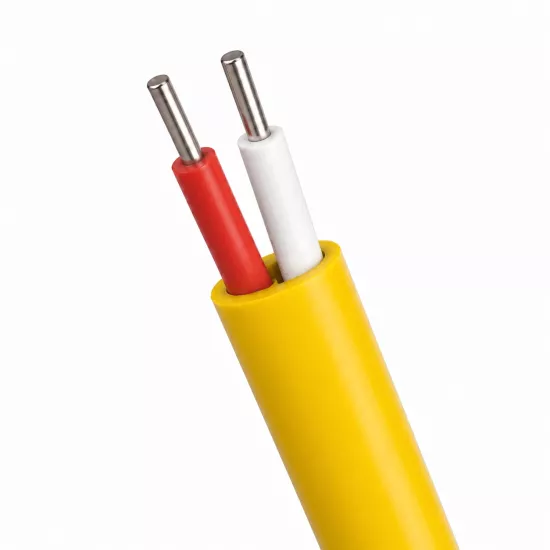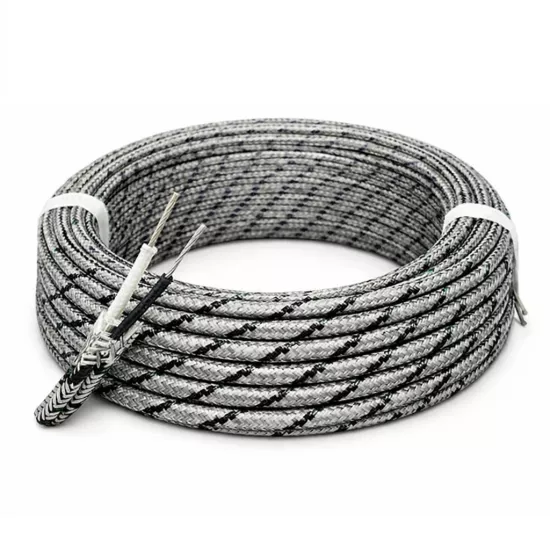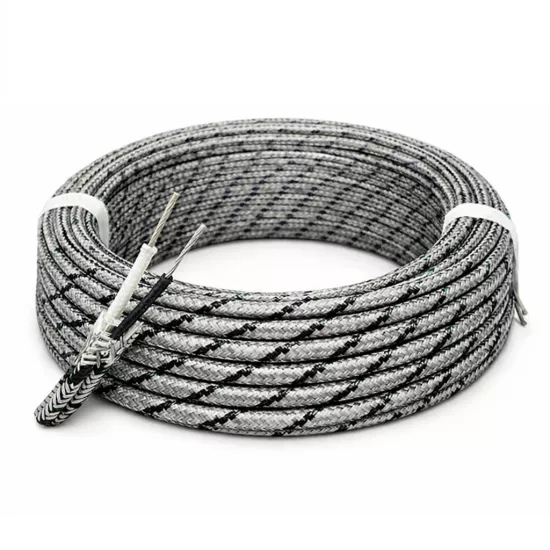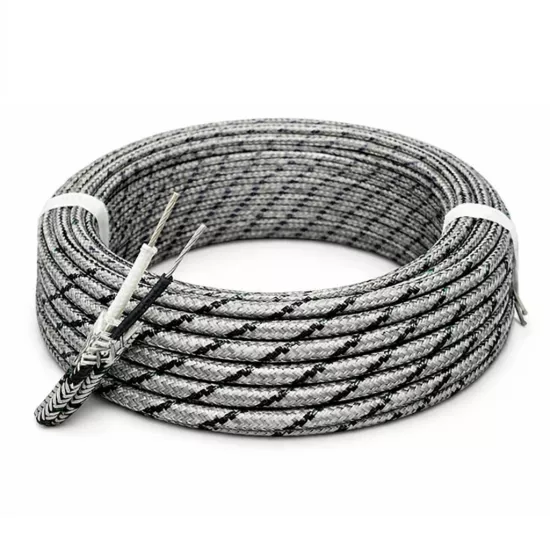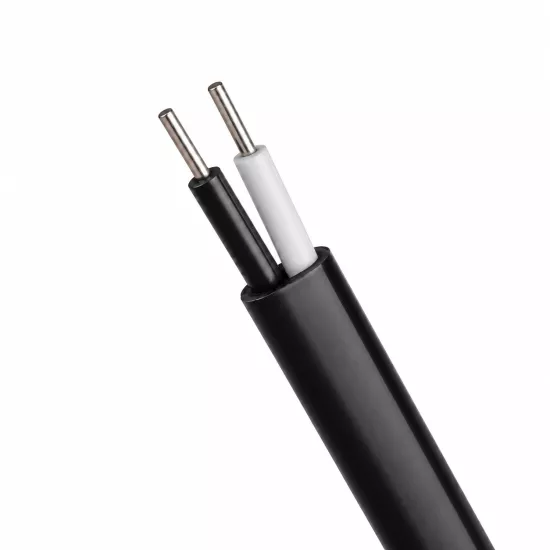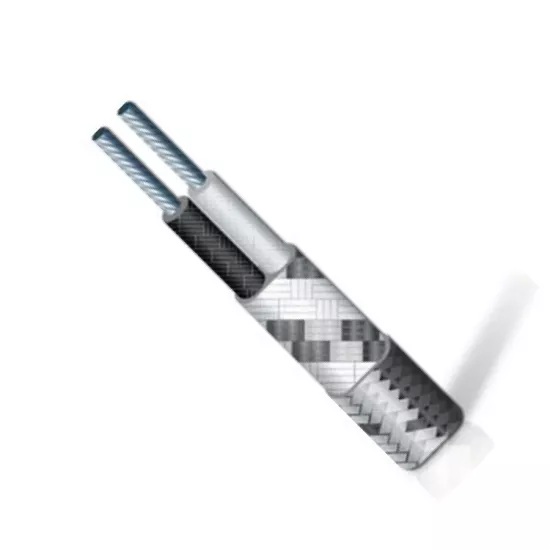
J-Type ANSI Teflon Thermocouple Cable 2x0.50 mm² is a Teflon-insulated temperature measurement cable used in J-Type Fe-Const thermocouple measurement circuits. It is used to transmit the thermoelectric signal generated by the thermocouple sensor to the temperature controller, indicator, data logger, PLC system or control panel.
The two-core cable has a 2x0.50 mm² cross-sectional area and combines mono/solid thermoelement conductors with Teflon insulation. The positive conductor is iron (Fe), while the negative conductor is the copper-nickel (CuNi) alloy known as Constantan.
This product is not a standard power cable. It should be used to establish or maintain the measurement circuit with the appropriate thermoelement structure. For accurate measurement, the cable must be compatible with the J-Type thermocouple and the positive-negative core polarity must be maintained throughout the connection.
The positive and negative thermoelement conductors of the cable are separately insulated with Teflon material. The insulating layer helps electrically protect the measurement line by preventing conductors from touching each other or surrounding conductive surfaces.
Teflon insulation is preferred in industrial measurement applications that require temperature, chemical contact and low-friction surfaces. The exact operating temperature and chemical compatibility of the cable must be evaluated according to the manufacturer's technical data.
In a mono/solid conductor construction, each core consists of a single wire. This structure provides consistent terminal connections in fixed installations and panel connections. In applications with constant movement, intense vibration or repeated bending, installation conditions must be evaluated separately.
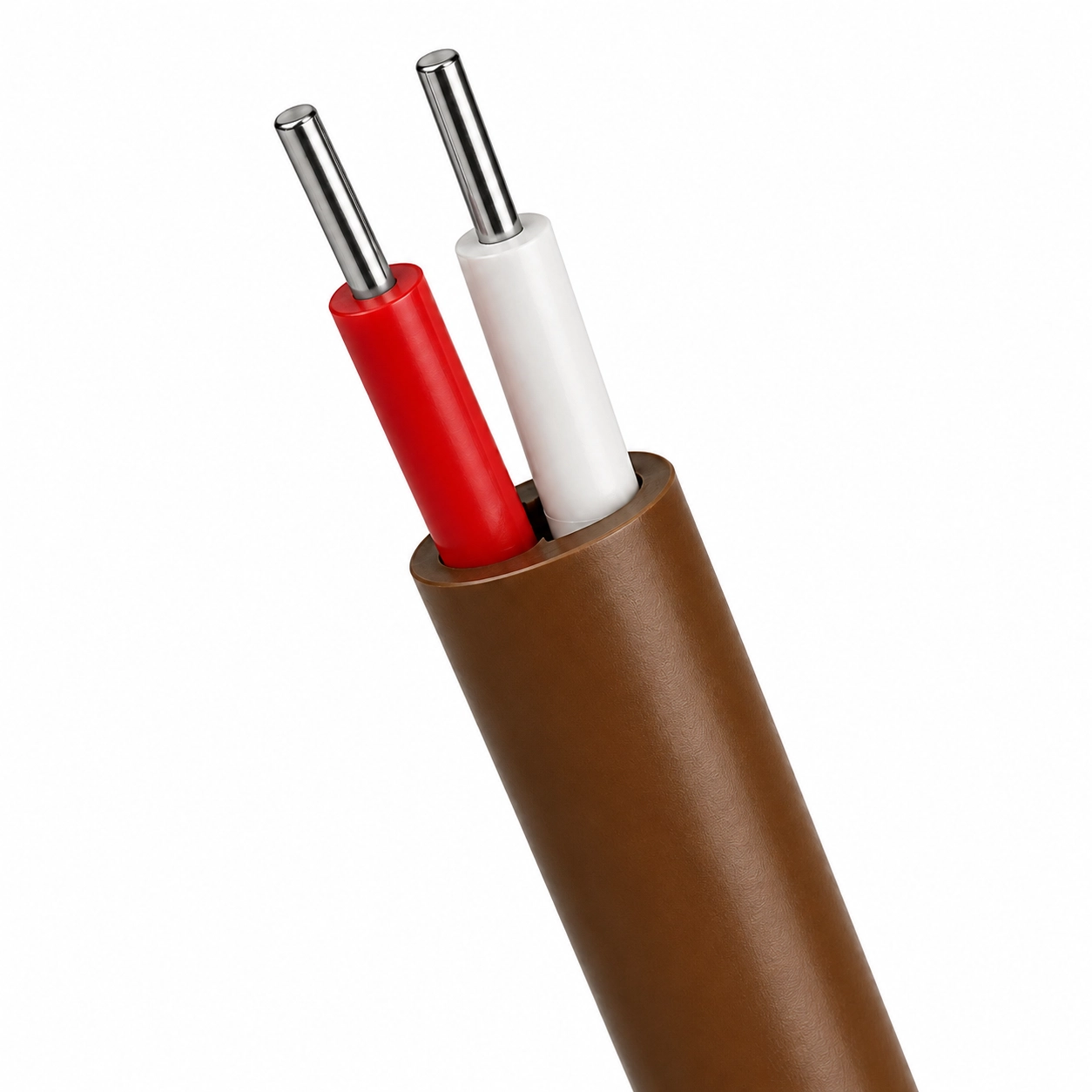
This J-Type thermocouple cable uses ANSI color coding. Under the ANSI color scheme, the white-insulated Fe conductor indicates the positive (+)and the red-insulated CuNi conductor indicates the negative (-) connection.
The outer sheath color of the product is brown. Thus, the general outer construction of the cable and its white and red cores can be easily distinguished from each other during installation, maintenance and fault detection.
Different color code systems can be used on thermocouple cables, such as ANSI, IEC and JIS. Therefore, the same J-Type thermocouple cable may have different core or outer sheath colors depending on the standard used and the cable class.
The measurement principle does not change between an ANSI-color-coded J-Type thermocouple cable and J-Type cables using other color standards, provided that their thermoelement alloys are the same. The difference is the colors used to identify the positive and negative conductors.
When connecting to an old installation or controller with different color standards, the process should not be based solely on the core color. Thermocouple type, conductor alloy, polarity markings and device connection diagram should be checked together.
J-Type thermocouple cable enables the line between the sensor and the measuring instrument to be established with the Fe-Const thermoelement structure. Choosing the cable compatible with the sensor type helps reduce measurement deviations that may arise from improper metal combinations at the connection points.
The 2x0.50 mm² construction offers a balance between mechanical strength and practical installation for control-panel connections and field applications. When selecting the cable cross-sectional area, the connection distance, terminal size, installation space, and thermocouple connector should be considered together.
Offering a tougher structure than cables with thinner cross-sections, it can help the cable to be used in a more controlled manner in internal panel transitions, fixed sensor lines and terminal connections.
Teflon insulation provides advantages in applications requiring temperature, chemical contact and low-friction surfaces can facilitate the routing of cable through appropriate cable ducts, panel pass-throughs and machine connection points.
Easy separation of white and red cores facilitates polarity control during installation and maintenance. In facilities where the ANSI color scheme is used, it helps to track the cable in accordance with the current panel and maintenance standard.
Teflon is preferred in industrial temperature measurement applications that require insulation, temperature and chemical resistance. The low-friction surface of the insulation material can make it easier to pass the cable through appropriate channels and transition points.
Its mono/solid conductor structure ensures regular use in fixed installations and panel connections. However, in applications where the cable is constantly moving, exposed to vibration or frequently bent, alternatives with flexible conductors should be considered.
When determining the actual usage conditions of the cable, the insulation material must not be the only consideration. Ambient temperature, chemical contact, mechanical movement, minimum bending conditions, wiring route, connection points and the terminal or connector used should be evaluated together.
In a J-Type thermocouple circuit, the positive and negative conductors must be connected to the correct terminals. Under the ANSI color code, the white core indicates the positive (+)and the red core indicates the negative (-) connection.
Reversed polarity may cause the measured value to move in the wrong direction as the temperature changes or cause the device to display an incorrect value. The positive and negative terminal markings on the controller, indicator, or PLC must be checked before connection.
When making the connection, use a cable, terminal, and thermocouple connector compatible with J-Type. The use of a standard copper connection cable, a cable for a different thermocouple type or unsuitable connection elements may cause measurement deviation.
If connection is to be made to an existing installation with an IEC color code, the colors should not be directly matched to each other. Since the core colors in ANSI and IEC systems are different, the positive and negative ends must be matched according to the terminal markings and wiring diagram.
Due to its mono/solid conductor structure, the cable should not be stressed on routes with constant movement or frequent bending. The cable must be protected from sharp edges, crush points and direct flame contact.
Thermocouple cable should be routed as far as possible from motor supply lines, inverter outputs and high-current power cables. In applications where electrical noise is intense, appropriate shielding and installation methods should be evaluated.
This product is sold by the meter, not in fixed cable length variants. The value entered in the order quantity field on the product page represents the total cable length to be ordered in meters.
When determining the order quantity, installation allowance should be added to the required connection distance. Internal panel routes, cable channels, turning points and terminal connection margins must be taken into account.
When choosing J-Type ANSI thermocouple cable, sensor type, thermoelement alloy, color code standard, conductor cross-section, conductor structure, insulation material, connection distance and measuring instrument to be used should be evaluated together.
This product is suitable for J-Type Fe-Const thermocouple measurement circuits. For K, T, N, E, R, S or different types of thermocouple sensors, a measurement cable suitable for the relevant thermocouple type must be used.
If the existing system is prepared according to the ANSI color code, using the same color standard facilitates cable tracking during installation, maintenance and fault detection. If a connection is to be made to a system with a different color standard, matching should be done not only on color but also on polarity and terminal diagram.
Mono/solid conductor structure may be preferred in fixed connections. In applications involving continuous movement, intense vibration or repetitive bending, cable options with flexible conductors should be considered.
This product is suitable for J-Type Fe-Const thermocouple sensors and measurement circuits.
ANSI color coding is an American color coding system that allows thermocouple type and positive and negative conductors to be identified with specific colors. For J-Type, the positive core is defined as white and the negative core is defined as red.
No. As long as the thermoelement alloys are of J-Type Fe-Const structure, the measurement principle is the same. The main difference is the standard by which core and outer sheath colors are defined.
The outer sheath of the product is brown. Positive Fe core has white insulation, negative CuNi core has red insulation.
The expression 2x0.50 mm² indicates that the cable consists of two cores and each core is in cross-section class 0.50 mm².
A mono/solid conductor means that each core consists of a single wire. It provides a consistent terminal connection in fixed installations; however, the operating conditions must be evaluated separately for applications involving continuous movement and frequent bending.
Teflon insulation is preferred in industrial temperature measurement cables due to its temperature and chemical resistance and low-friction surface properties. The exact operating conditions must be determined according to the manufacturer's technical documentation.
No. This product is used to transmit a thermocouple measurement signal. It must not be used to power motors, heating elements, or similar electrical loads.
This product has no fixed cable-length variant. The quantity entered in the order field is the number of meters ordered. For example, entering 10 units orders 10 meters of cable.
The manufacturer's technical data sheet should be used as the basis for the exact operating temperature of the cable, technical type of Teflon insulation, conductor tolerance, external dimensions, operating voltage and other electrical properties. Thermocouple type, ANSI color standard, connection distance, mechanical conditions and device terminal structure should be evaluated together during product selection and installation.




 EN
EN Türkçe