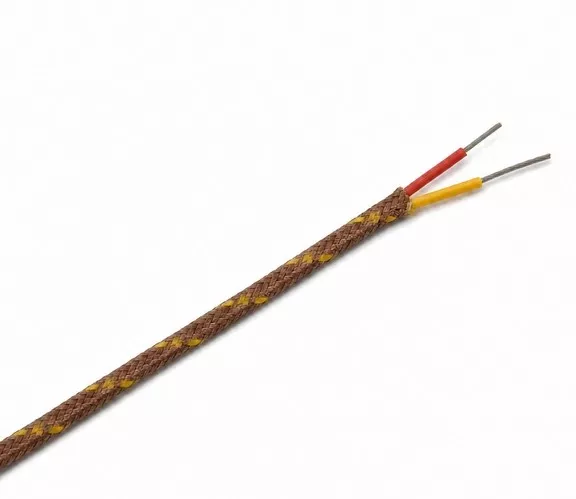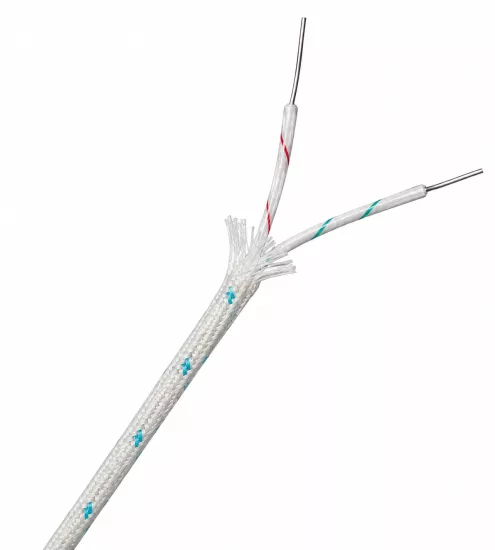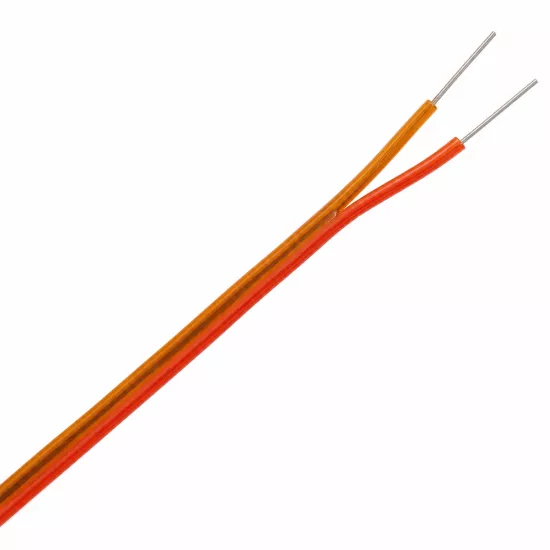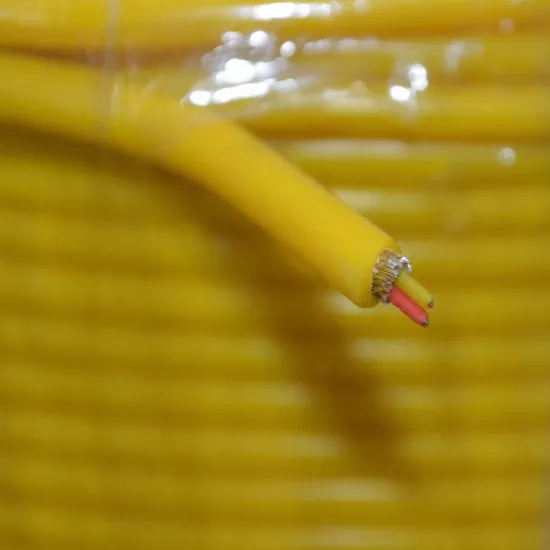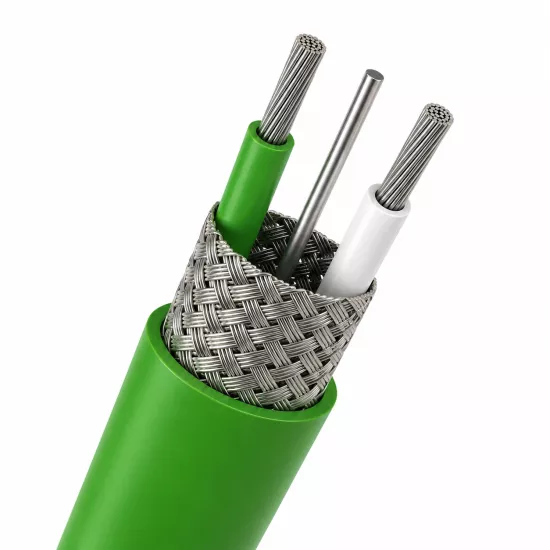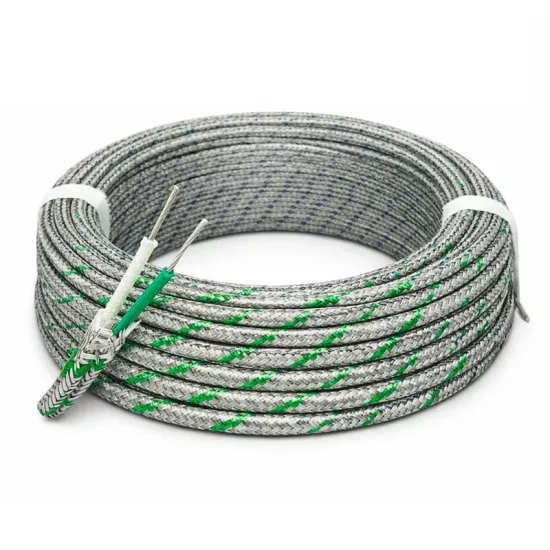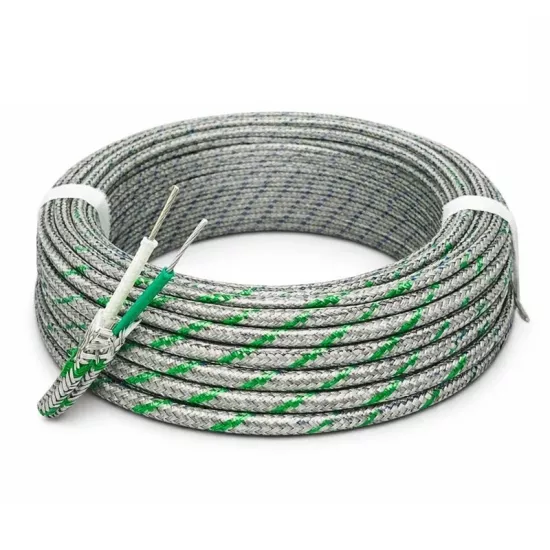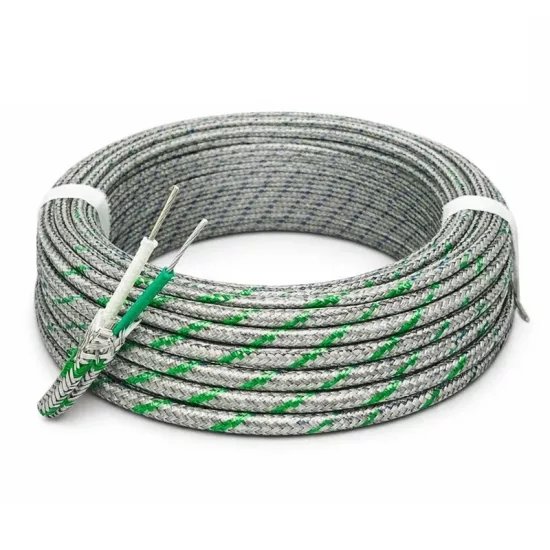
K-Type Cu/CuNi PVC Compensating Cable KCVV-2*7/0.3-JIS is used in the measurement circuit between a K-Type thermocouple sensor and a temperature indicator, controller, data logger, or PLC.
The cable's positive conductor is copper (Cu), while its negative conductor is a copper-nickel (CuNi) alloy. Each core has a stranded conductor made from 7 wires, each 0.30 mm in diameter. This construction provides an approximate conductor cross-sectional area of 0.50 mm² per core.
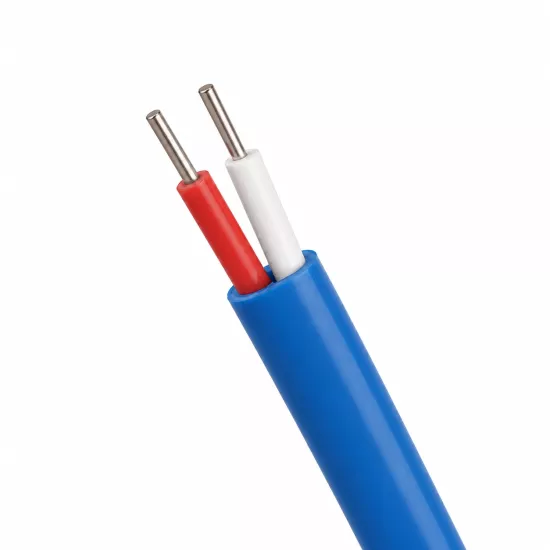
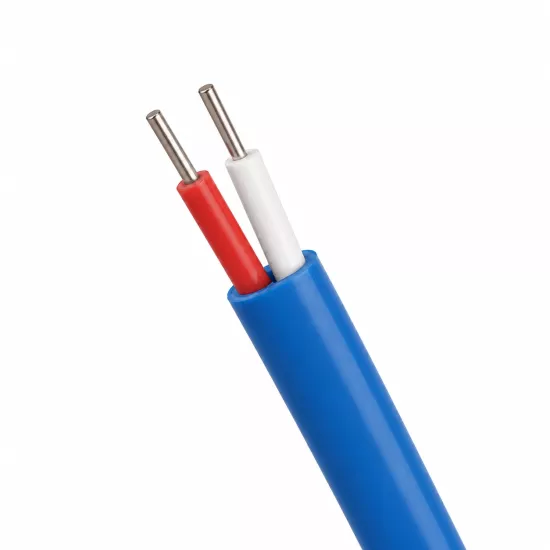
Core insulation and blue outer sheath are made of PVC. In the product, red positive (+) and white negative (-) cores are used in accordance with the JIS color coding.
This product is not K-Type NiCr-Ni thermocouple wire or KX extension cable. It is a K-Type compensating cable with Cu/CuNi conductors and must be used to extend the measurement circuit from the cold-junction side of a K-Type thermocouple to the controller under suitable environmental conditions.
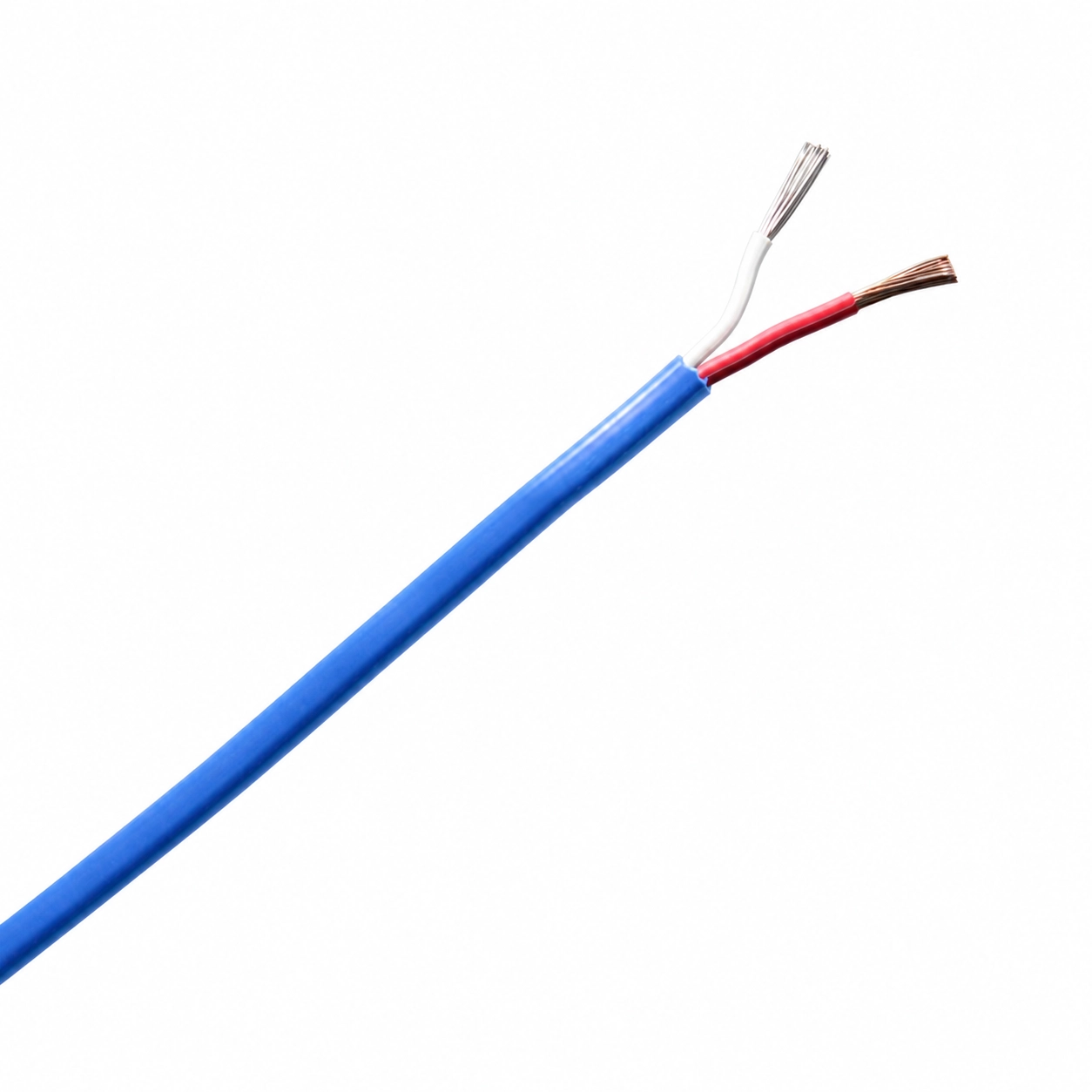
The copper conductor in the cable's positive core appears copper-colored at the stripped end. The CuNi conductor in the negative core has a gray or silver appearance. The difference in appearance between the two cores results from the conductor alloys used.
Its multi-stranded conductor structure helps the cable to be shaped more easily in panel and device connections. This feature provides ease of installation in terminal connections, fixed measurement lines and in-machine cabling applications.
PVC used in core insulation and outer sheath creates a flexible and applicable cable structure under normal industrial environment conditions. The blue outer sheath holds the inner cores together and provides essential mechanical protection.
The compensating cable is used to maintain the temperature measurement circuit between the thermocouple sensor and the measuring instrument with appropriate electrical characteristics. The conductors of the compensating cable do not have to consist of the same alloys as the thermocouple element.
In this product, copper and copper-nickel conductor pairs are used for the K-Type thermocouple measurement system. Therefore, the cable is not at the hot measurement point of the thermocouple. It should be used on the cold connection side of the sensor and on the measurement line going to the controller.
A K-Type thermocouple measurement junction must not be formed by joining the red and white cores. A NiCr/NiAl-based thermoelement pair suitable for K-Type must be used to manufacture K-Type sensors.
K-Type Cu/CuNi PVC compensating cable In the KCVV-2*7/0.3-JIS model, JIS color-coded structure is used to distinguish the cores and outer sheath.
The conductor of the red positive core is copper, and the conductor of the white negative core is CuNi alloy. Therefore, when the cable ends are peeled, it is normal for the red core to appear copper-coloured and the white core to appear grey-silver.
Thermocouple cables have different color coding systems such as JIS, IEC and ANSI. The same thermocouple type can be produced with different core and outer sheath colors depending on the standard used. During connection, no action should be taken based solely on cable color. Thermocouple type, conductor structure and polarity information should be checked together.
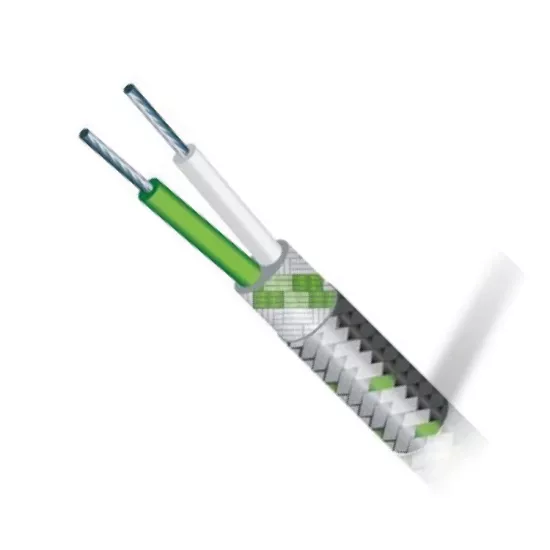
While IEC color-coded K-Type cables generally have a green-white core structure, this product has red-white cores and a blue outer sheath. This difference arises from the color coding system followed by the product.
The Cu/CuNi conductor structure allows the measurement line on the cold connection side of K-Type thermocouples to be continued with the appropriate compensating cable. It can be used in control and panel connections where the ambient temperature remains within the cable limits.
The stranded-conductor construction makes the cable easier to shape at terminal and control-panel connections. Its flat, compact outer profile facilitates installation through narrow cable passages and at device connections.
Easy separation of red and white cores makes polarity tracking easier during assembly. The blue outer sheath helps visually identify the cable as the color-coded thermocouple connection line JIS.
PVC core insulation and PVC outer sheath give the cable a flexible and easy-to-apply structure. Product. It can be used in thermocouple connections inside the panel, around the machine and under normal industrial environment conditions.
According to the manufacturer's technical data, the operating temperature of the cable is between -20°C and +105°C. This temperature value is valid for the environment where the cable is located. It does not represent the total temperature measurement range of the K-Type thermocouple sensor.
The cable must be protected from direct flame contact, hot oven surfaces, molten materials, sharp edges and crush points. When determining the cable route, ambient temperature, mechanical movement and external factors should be evaluated together.
In the K-Type thermocouple measurement circuit, the positive and negative conductors must be connected to the correct terminals. In this product red core indicates the positive (+)and the white core indicates the negative (-) connection.
The red positive core is connected to the K-Type positive terminal of the temperature controller or indicator. The white negative core should be connected to the negative terminal.
Reverse polarity may cause the indicator to drop or the measurement value to change incorrectly as the temperature rises. Device terminal diagram and polarity markings should be checked before connection.
This cable should only be used in the K-Type thermocouple measurement circuit and in the appropriate cold connection area. It should not be used in measurement circuits of J, T, E, N, R, S or different thermocouple types.
The product is not a power supply cable. It should not be used to power electric motors, heating elements, heaters or similar power loads.
| Feature | KCVV-2*7/0.3-JIS | KX extension cable |
|---|---|---|
| Cable class | K-Type compensating cable | K-Type extension cable |
| Positive conductor | Copper (Cu) | NiCr-based alloy |
| Negative conductor | Copper-nickel (CuNi) | NiAl or equivalent KX alloy |
| Basic use | Compensation in the cold junction area | Extension of K-Type thermocouple line with suitable KX alloys |
| Can a measuring junction be made? | No | It can be used if appropriate materials and production conditions are provided. |
When choosing a cable, thermocouple type, conductor alloy, ambient temperature, terminal structure of the measuring instrument, color code and connection route should be evaluated together.
If the cable line passes only through the control panel or low temperature connection area, Cu/CuNi compensating cable can be used. If the cable passes through a warmer area or the same basic alloys as the thermocouple are required, the appropriate KX extension cable should be preferred.
If the existing system has an IEC or ANSI color code, just matching the colors is not enough. Positive and negative terminals should be checked, device schematic examined and conductor polarity verified.
The product is a compensating cable used in the K-Type thermocouple measurement circuit. Conductors consist of copper and copper-nickel alloy. It is not a KX extension cable with NiCr/NiAl conductor.
Yes. The conductor of the red positive core is copper. For this reason, when the core is stripped, the conductor appears in copper color, which is compatible with the technical structure of the product.
Copper-nickel alloy is used in the white negative core. This alloy appears gray or silver, not red like pure copper.
No. The Cu/CuNi conductors must not be joined to form a K-Type thermocouple measuring junction. A suitable NiCr/NiAl thermoelement pair must be used to manufacture a K-Type sensor.
The code denotes a two-core cable construction with PVC-insulated cores and a PVC outer sheath. Each core consists of 7 wires, each 0.30 mm in diameter. JIS denotes the product's color-coding system.
In the color-coded structure of this product JIS, the red wire indicates positive (+) and the white wire indicates negative (-) connection. The outer sheath is blue.
No. Different color codes are used in IEC, ANSI and JIS systems. For this reason, cables of the same thermocouple type may have different core and outer sheath colors.
According to the manufacturer's technical data, the operating temperature of the cable is between -20°C and +105°C. This value is valid for the environment where the cable is located. It does not show the total measuring range of the thermocouple sensor.
The cable has PVC insulation and Cu/CuNi compensation structure. It should not be taken directly to the hot measurement area or to environments above +105°C. On hotter routes, a different thermocouple cable with appropriate insulation and conductor class should be used.
No. The product is used to transmit a low-level thermocouple measurement signal. It must not be used to power a heating element, motor, or any other power load.
In product selection, the manufacturer's technical data for the KCVV-2*7/0.3-JIS model should be used as the basis. Before application, the conductor alloy, color code, polarity, operating temperature, cable size and terminal structure of the device to be connected should be checked together.




 EN
EN Türkçe